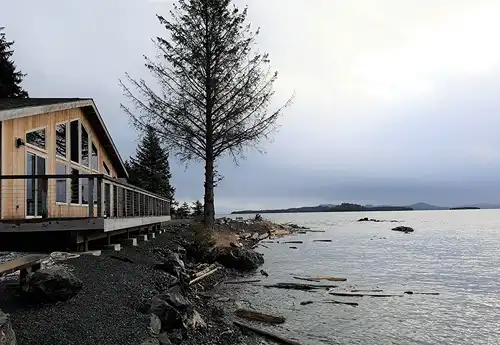
The Organized Village of Kasaan Tribal Hall, site of the small boat workshop. Photo courtesy Department of Commerce, Community and Economic Development Division of Community and Regional Affairs’ Community Photo Library.
For the people of Kasaan, small boats are a big deal.
That’s why Alaska Sea Grant recently conducted a maintenance, operation and safety workshop in the Prince of Wales Island community focused on the outboard-powered skiffs locals routinely use for subsistence. The event grew from discussions between Gabe Dunham, head of Alaska Sea Grant’s Marine Advisory Program, and Frank Nix, Cultural Foods Manager for the Organized Village of Kasaan.
“He (Frank Nix) wanted to help people gain the knowledge to take advantage of traditional foods,” Dunham explained. “He’s looking at it from the perspective of, how do we create an educational event that people in Kasaan can really derive some value from, and that can help them access local foods?”
Kasaan is a Haida village of around 65 residents located on Kasaan Bay, on the eastern side of Prince of Wales. The village’s protected location means small skiffs with outboard motors are commonly used for fishing, and are also a popular way to access hunting and gathering spots.
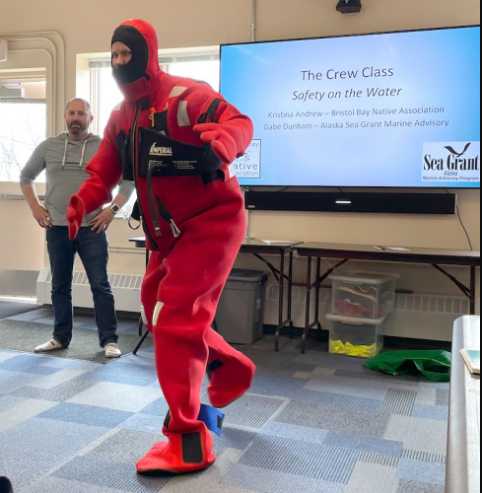
With that in mind, Dunham organized and led a three-day small boat workshop, which drew eight attendees ranging from teenagers to 60-year-olds. The first day and a half focused on repair and maintenance of small engines and boats, followed by an afternoon on aspects of boating like knots, float plans, and marine safety. Dunham drew content from multiple sources: a long-running Alaska Sea Grant curriculum for small engine maintenance, the Alaska Marine Safety Education Association’s (AMSEA’s) Onboard Drill Conductor course, and even an AMSEA class for novice women boaters called “Boating Without the Boys.”
“It is an amalgamation of workshop content from several different workshops,” Dunham noted. “It’s not just all about fixing outboards. It’s about the boat more holistically and operating the boat in a safe way.”
The first two days of the course were held indoors at the Organized Village of Kasaan Tribal Hall, then for day three the class decamped to Kasaan’s harbor for hands-on maintenance demos and safety drills. Dunham served as the man overboard for drill purposes, swimming in a survival suit—as is required for all AMSEA safety instruction—even though it was a scorching hot day.
“I felt pretty silly,” he laughed. “There were kids swimming in the harbor with little inflatable floaties.”
Dunham said the workshop garnered glowing feedback from all attendees. He hopes to continue offering similar “hyper-localized” training in other communities, and is in discussions to hold one in another village elsewhere in the state. As for Kasaan and its neighbors, Dunham hopes that local organizations and instructors on Prince of Wales Island will take the idea and run with it.
“That’s an important feature of the Sea Grant model,” he said. “That is to start something that meets the needs of the people in the region and then provide support so it can continue to be a going concern on its own.”