Webinar discusses devastation caused by invasive northern pike
By Julie Stricker-UAF on Comments Off on Webinar discusses devastation caused by invasive northern pike
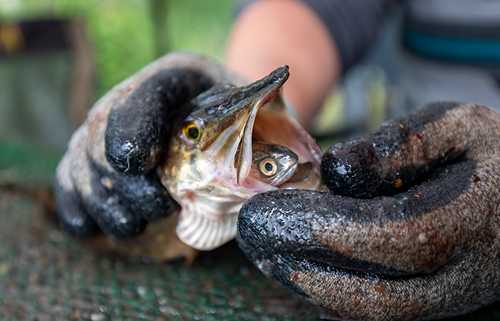
Photo courtesy of Alaska Department of Fish and Game. A captured northern pike holds a juvenile coho salmon in its mouth. Pike are apex predators that have been introduced to Southcentral Alaska, where they have become an invasive problem.
Northern pike are native to Alaska north and west of the Alaska Range but were illegally introduced to Southcentral in the 1950s, where they have spread to more than 150 water bodies. As apex predators, pike have greatly altered many aquatic ecosystems.
A free Zoom webinar from noon-1 p.m. on Wednesday, March 18, will provide an overview of how northern pike became an invasive problem in part of Alaska. The webinar is hosted by the University of Alaska Fairbanks Cooperative Extension Service.
Parker Bradley, a biologist with the Alaska Department of Fish and Game, will highlight statistics that depict the impact pike have had in the Mat-Su Valley. He will also discuss the department’s suppression and eradication projects and the research showing how pike move through Cook Inlet.
For more information, contact Molly Johansson at 907-786-6313 or mjohansson@alaska.edu.
ADDITIONAL INFORMATION: Accommodation requests related to a disability should be made five business days in advance to Alda Norris at amnorris2@alaska.edu or 907-474-7120. Language access services, such as interpretation or translation of vital information, will be provided free of charge to individuals with limited English proficiency upon request to amnorris2@alaska.edu.
This work is supported by the U.S. Department of Agriculture’s National Institute of Food and Agriculture.