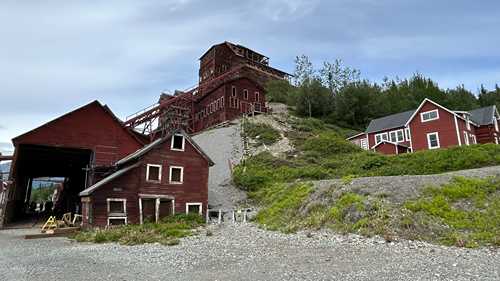
Photo by Rod Boyce The towering Kennecott Mines copper mill sits on a mountainside in Wrangell-St. Elias National Park and Preserve. The mill processed ore from the company’s Bonanza, Jumbo, Mother Lode, Erie and Glacier mines. The restored mine office is at right.
Kennecott has been spruced up quite a bit since my last visit there nearly 30 years ago.
Even so, many crumbling buildings remain. Some have been shored up by the National Park Service, which now manages the site as Kennecott Mines National Historic Landmark in Wrangell-St. Elias National Park and Preserve. A few other buildings have been restored.
Several exhibits show the history and workings of the once mighty mine, which produced copper from high-grade ore from 1911 to 1938. The Park Service displays and signs that visitors see today were not there on our first visit.
I doubt any of us on our family trip back in 1997 or 1998 knew we were likely walking on the source of it all.
Copper. Lots of it, including masses of nearly pure chalcocite, a mineral that is almost 80% copper by weight.
On our visit in mid-July of the current year, we learned a lot about copper production from our guide at St. Elias Alpine Guides. We had signed up for a two-hour tour of the 14-story mill, the building that dominates almost any Kennecott postcard.
That got me wondering why Kennecott had so much copper.
What geologic processes created this abundance? Why was the ore so rich in copper?
Alan M. Bateman and D.H. McLaughlin had some of the answers in 1920, when their research into Kennecott appeared in the science journal Economic Geology. They titled their work, “Geology of the ore deposits of Kennecott, Alaska.”
Bateman and McLaughlin worked in the field together in 1915, just four years after the mine started production.
Bateman, who worked for the Kennecott Mining Co., continued field work for four more years. McLaughlin did laboratory work as part of a mining industry effort to better understand how natural processes can make an ore deposit richer after it forms.
“The copper deposits of the famous Bonanza and Jumbo Mines at Kennecott, Alaska, are unique for the character of their ores and their purity and size,” the pair wrote more than a century ago. “Their occurrence presents many peculiar and interesting features, and the origin of the great masses of chalcocite has long been a puzzle.”