By Jennifer AZngelo-NOAA on Comments Off on Mapping Alaska’s Wild Kelp Beds with Farmers
NOAA Fisheries and seaweed farmers team up to chart wild kelp beds, helping grow Alaska’s seaweed aquaculture industry
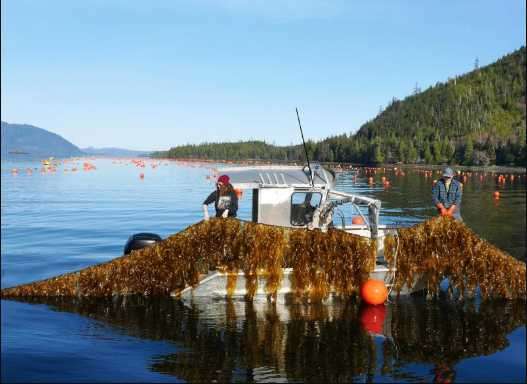
Alaska’s coastline holds vast, untapped potential for seaweed aquaculture—but knowing exactly where wild kelp grows is critical for sustainable expansion. A new mapping project, led by NOAA Fisheries in collaboration with Alaska Sea Grant and local farmers, is working to locate these wild kelp beds. This will help:
Source healthy kelp for farming
Assist farmers in meeting state permitting requirements
Support NOAA’s Aquaculture Opportunity Areas identification process
Aquaculture Opportunity Areas
NOAA Fisheries and NOAA’s National Centers for Coastal Ocean Science are working with the State of Alaska to identify Aquaculture Opportunity Areas (AOAs). These are defined geographic regions that might be well-suited for multiple sustainable commercial aquaculture operations. These areas are selected through a combination of spatial analysis, Indigenous Knowledge, environmental review, and public engagement. This process ensures both local voices and the best available science guide the process.
Using spatial planning tools, scientists can layer information about ecosystems, ocean conditions, and human uses of the coast. This allows them to see where aquaculture could flourish with the least conflict and the greatest benefit. The result is a clearer picture of where seaweed and shellfish farming might grow sustainably while protecting the health of Alaska’s waters and communities.
In Alaska, seaweed farming is still an emerging industry, and AOA planning helps provide a strong foundation for developing aquaculture. Mapping wild kelp beds is a critical step in this process. It will ensure farmers, managers, and communities have the information they need to make informed decisions about the best locations for establishing farms.
Kelp Farming in Alaska
One of the most important guidelines shaping Alaska’s seaweed industry is something farmers call the “50-50 rule.” Put in place by the Alaska Department of Fish and Game, this policy is designed to keep both farmed and wild kelp populations healthy.
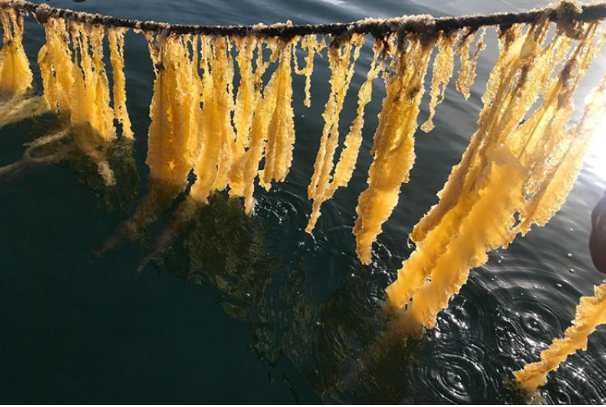
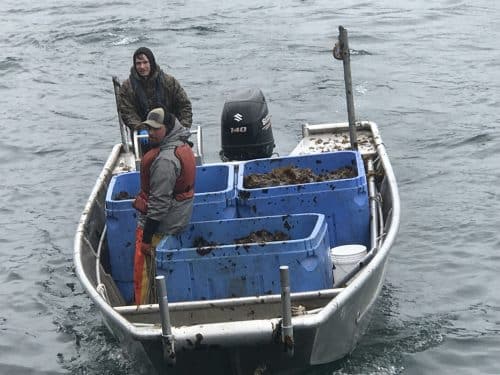
Here’s how it works: Farmers collect spores from at least 50 wild kelp plants to start their seedstock. These spores must be collected from donor beds located within 50 kilometers of the farm site. This practice ensures that farms don’t rely too heavily on a single source, and helps local wild populations continue to thrive. Because of this rule, the location of wild kelp beds plays a big role in where farms are placed.
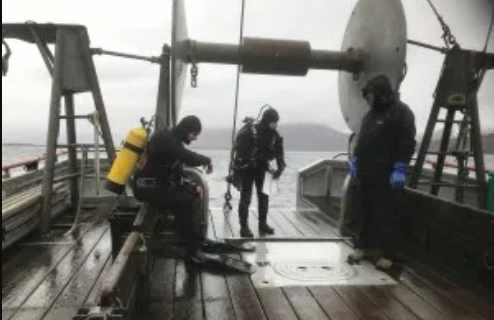
The kelp mapping project combines local knowledge, existing datasets, and geographic information system mapping tools to build a clearer picture of wild kelp bed locations. By interviewing active seaweed farmers, researchers pinpoint key donor beds near existing farms and compile location data into detailed maps.
This data is shared through NOAA’s Alaska AOA initiative to help identify suitable areas for aquaculture and support industry growth. It is available for download on the NOAA Geoplatform.
Example map of the Cordova study area showing wild kelp beds (red polygons) from the participatory mapping effort and draft AOA options, with intertidal options in red and subtidal options in purple. Additional data include ADF&G genetic kelp collections (green centroids). Credit: NOAA Fisheries.
Mapping the Future
Maps of wild kelp beds provide valuable data for evaluating locations for seaweed aquaculture development in Alaska. They highlight areas well-suited for meeting kelp sourcing requirements by the State, and identify potential challenges in regions with fewer nearby wild kelp beds.
Many existing datasets on kelp distribution were created for other purposes, leaving gaps in coverage or detail.
This project incorporates farmer knowledge, aerial surveys, and genetic sampling to add new layers of information—building a more complete picture. Together, these contributions strengthen the foundation for planning Alaska’s aquaculture future and ensure decision-makers have the best and broadest data available.
 Alaska’s coastline holds vast, untapped potential for seaweed aquaculture—but knowing exactly where wild kelp grows is critical for sustainable expansion. A new mapping project, led by NOAA Fisheries in collaboration with Alaska Sea Grant and local farmers, is working to locate these wild kelp beds. This will help: