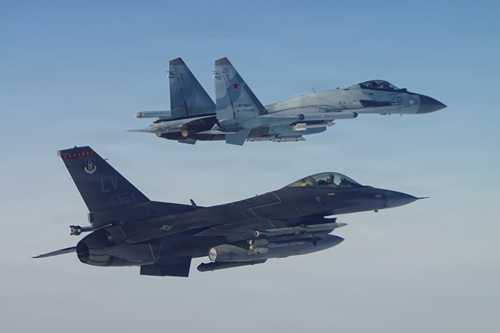
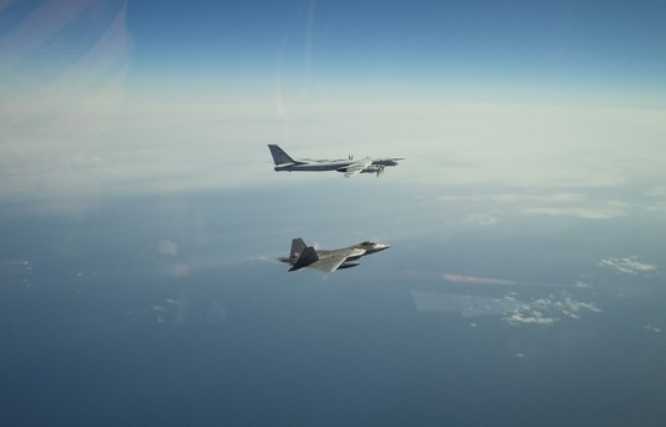
This photo provided by the U.S. Department of Defense shows a North American Aerospace Defense Command F-16 fighter aircraft intercepting a Russian Su-35 military aircraft near the Bering Strait, west of Alaska, on Thursday, Feb. 19, 2026.
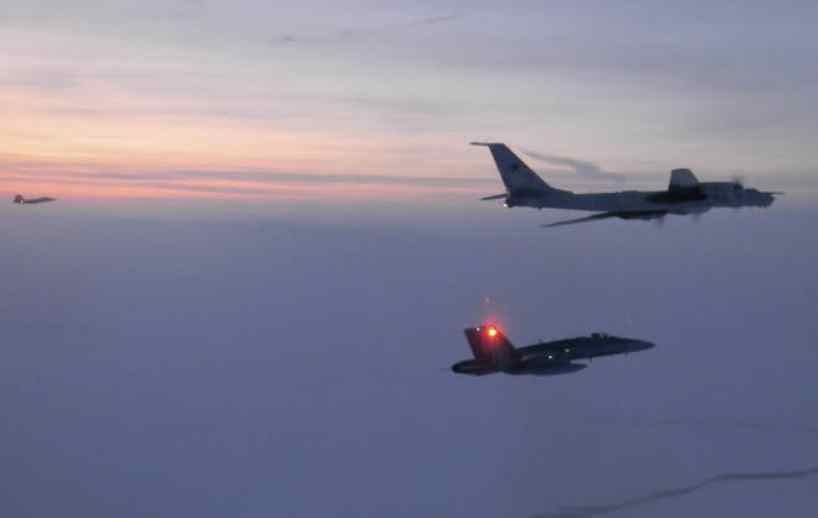
PETERSON SPACE FORCE BASE, Colo. – The North American Aerospace Defense Command (NORAD) detected and tracked two Russian TU-142 military aircraft operating in the Alaskan and Canadian Air Defense Identification Zones (ADIZ) on March 4, 2026.
NORAD launched two U.S. Air Force F-35 fighter aircraft, two F-22 fighter aircraft, four KC-135 tankers, one E-3 AWACS, two Canadian CF-18 fighter aircraft, and one CC-150 tanker to positively identify, monitor, and intercept the Russian aircraft in the American and Canadian Air Defense Identification Zones.
The Russian aircraft remained in international airspace and did not enter American or Canadian sovereign airspace. This Russian activity in the Alaskan and Canadian ADIZ occurs regularly and is not seen as a threat.
An ADIZ begins where sovereign airspace ends and is a defined stretch of international airspace that requires the ready identification of all aircraft in the interest of national security.
NORAD employs a layered defense network of satellites, ground-based and airborne radars and fighter aircraft to detect and track aircraft and inform appropriate actions. NORAD remains ready to employ a number of response options in defense of North America.