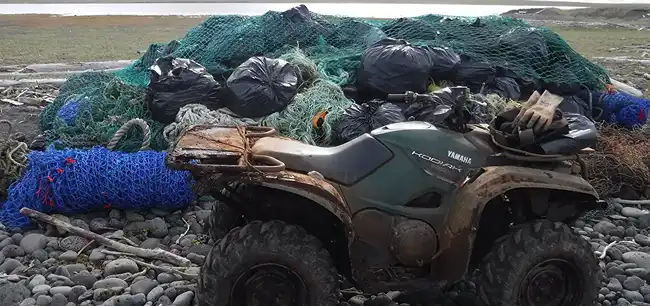
A pile of debris gathered from a previous cleanup, similar to what was collected in Brevig Mission and Wales. Photo courtesy Norton Sound Economic Development Corporation.
The Norton Sound Economic Development Corporation (NSEDC) brings a lot to the Bering Strait region, including jobs, financial assistance, education and training. But equally noteworthy is what the corporation recently took away: more than 63,000 pounds of marine debris and derelict vessels from around the villages of Wales and Brevig Mission.
The Wales and Brevig Mission cleanups received support from Alaska Sea Grant’s Alaska Center for Marine Debris, which has sponsored 17 marine debris removal projects around the state since 2024. The twin efforts add to a long history of cleanups led by the NSEDC, which since 2006 has removed over 1.2 million pounds of marine debris across 15 member communities.
“We receive a lot of positive feedback from our communities about this work,” said Renae Ivanoff, director of NSEDC’s Norton Sound Fisheries Research and Development Division (NSFR&D), which oversaw the efforts. “People like seeing nets and debris off of the beaches. We get calls asking when we’re coming out to do cleanups next.”
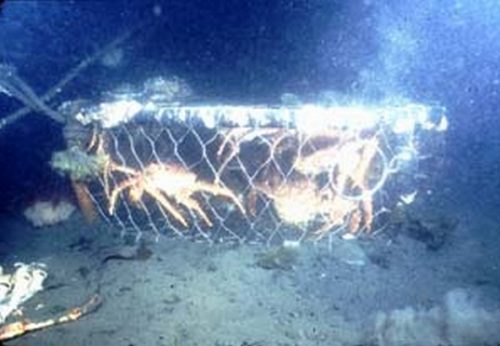
Wales and Brevig Mission both collect copious amounts of marine debris due to their location on the shores of the Bering Strait. Storms and currents wash in all manner of garbage from the high seas, from scrap metal and oil drums to large fishing nets, boats, and even entire shipping containers. The litter spreads across the beaches and tundra that residents rely on for subsistence resources, posing a hazard to both locals and wildlife.
“There have been reindeer that have gotten their antlers stuck in fishing nets,” recounted FredJay Ivanoff, senior crew leader for NSFR&D. “One of them even died because of it, so the debris impacts all of our fish and game here.”
The recent cleanups were conducted by local crews under the supervision of NSEDC staff. Workers in both communities faced challenging conditions, including rough terrain, thick mud, dense fog, and limited equipment and supplies, but they still hauled out monumental piles of litter. On the coastline north of Wales, they collected more than 28,000 pounds of debris, more than 19,000 pounds of which consisted of nets, lines and ropes. In Brevig Mission, a dozen derelict vessels littering the beach were hauled away by trailer, and the crew also removed 289 metal drums that originated from a nearby mining operation. The cleanups also netted smaller-scale trash, including plastics, foam and other miscellaneous debris.
In total, more than 54,000 pounds of trash plus around 9,000 pounds of derelict vessels were collected and removed from the two villages. Most of it was taken to the villages’ landfills or processed through local plastic recycling programs run by Tribal offices.
NSEDC aims to update the cleanup program yearly to fit the needs of its communities and adapt to the challenges of remote living. Over the years, the region has had to manage rising equipment costs along with the loss of airlines that served as crucial connections between villages. Through it all, NSEDC remains committed to cleaning up its communities.
“[People] have to be resilient in their lifestyle here and overcome many challenges,” Renae Ivanoff said. “We [at NSEDC] want to safeguard our resources as best as possible and do our part as stewards of the land and water.”