Sullivan Touts “Alaska Comeback,” Historic Opportunities, in Annual Address to Legislature
By Office of Senator Dan Sullivan on Comments Off on Sullivan Touts “Alaska Comeback,” Historic Opportunities, in Annual Address to Legislature
II.AlaskaComeback Theme
From fighting for statehood, to rebuilding after the 1964 earthquake, to the construction of the Trans-Alaska Pipeline, Alaskans, time and again, have demonstrated that we can overcome challenges and achieve our dreams when our leaders are aligned on policy, opportunity [and] private sector investment toward a common goal.
I believe we are at the beginning of another historic Alaska Comeback.
So the question naturally comes: What are we coming back from?
We’re coming back from this chart. I presented this last year. This is the 70 executive orders from the Biden administration—don’t worry, I’m not going to rip it up this time—all directly targeting Alaska, our economy, good-paying jobs, and our future. This has always been a goal of the far-left special interests in D.C., and they made significant progress—take a look—in achieving that goal under the Biden administration.
As you all know, the federal government, particularly in our state, has immense power. When it is concentrated to shut down an opportunity or opportunities in a single state, the consequences can be devastating. And they were.
III. Making it Happen: Alaska EO and the WFTCA
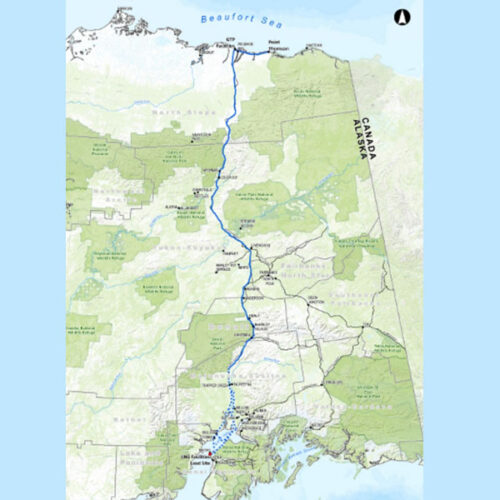
But, as I mentioned, we’re now beginning to see the beginnings of a real comeback, and real progress on goals we’ve dreamed about collectively for decades: an energy renaissance on the North Slope; a gas line that can finally reduce energy costs in our state and offer endless possibilities for the future; a rebuilt military and robust Coast Guard presence during a dangerous time; and a health care system that reflects the realities of delivering care in the most rural, high-cost health care state in America.
As we pursue these goals, we must keep as our North Star Alaska’s working families who continue to feel the strain of higher costs and uncertainties, families, by the way, who stand to benefit the most if we get this right collectively. But I have no doubt, the Alaska Comeback is underway with important drivers powering it.
First is a change in the direction of the executive branch. On day one—and I presented this last year, but it bears repeating—in the Trump administration, the President signed this executive order, “Unleashing Alaska’s Extraordinary Resource Potential.” It’s really important. And, as I’ve said to many elected officials across the state, whether you supported this administration and voted for them or didn’t, it doesn’t matter. We should use this. This is the federal government telling the world, telling Alaskans, and importantly, telling federal agencies that the Last Frontier Lock Up of Biden is over, and we are going to unleash Alaska’s economy, opportunity and future, and that is really important.
By the way, I think we have handouts on your desk. I like handouts, as you can tell. They help tell the story.
We are the only state that has [its] own executive order. Again, I think it’s really important.
Second, a really important driver of our comeback is that we passed the Working Families Tax Cuts Act.
I often refer to this legislation as the “Alaska Opportunity Act,” because so much in it tailored specifically for Alaska’s needs. My team and I fought hard to make this bill happen. And let me tell you, no state in the union did better than Alaska in this historic legislation. That is something that actually Democrats and Republicans back in D.C. actually agree on—that we did the best in this bill.
Since this bill passed in July, my team and I have been out all across Alaska doing town halls, doing meetings—we’ve done well over 60—meeting with families, and workers, and business owners, Alaska Native leaders, health care providers, and local officials. [I’ve been] listening to their concerns, but also [tried to] explain what’s in the bill, and then, very importantly, talking about the historic opportunities we have to work together on this legislation on its implementation.
That is really what I want to do with all of you all this morning.
Let me start with Alaska’s resource development economy, because nothing else we do succeeds without that. For too long—and I just gave you examples—Alaska has lived under a pendulum: One administration encouraging development of our economy and resources, then another administration coming in and saying, “No,” through executive orders, “we’re going to shut it down.”
That kind of instability discourages investment. Energy companies, large and small, do not operate on election cycles. In Alaska, as you all know, returns are realized over decades. Long-term capital requires long-term certainty.
That is exactly what the Working Families Tax Cuts Act does for Alaska.
When the president talks about this bill unleashing American energy, it’s really about unleashing Alaska energy. We stopped the pendulum and put certainty into the law as it relates to Alaska. Mandatory lease sales covering millions of acres for our state over the next 10 years in NPR-A, in ANWR, and in Cook Inlet.
In 2017, this body, with the Lieutenant Governor and the Speaker, presented to me a resolution that said, “Senator, it’s time to get ANWR open.”
It was a unanimous resolution from the Alaska Legislature. And in the 2017 Tax Cuts and Jobs Act, we did that. We got it open, in the law. But in a pattern we’ve seen before, that progress was illegally shut down by the Biden administration. A federal court in Alaska confirmed as much.
So, in this bill, we did it again, in statute. Now, this is a great opportunity for all of us. Because Alaska is now in the law on what has to happen for our state. When I was DNR commissioner, my team and I put together an ambitious, comprehensive plan to get our state back to a million barrels a day.
Of course, the skeptics came out in force. Alaska’s days as an energy powerhouse were over, they said. “We have to manage the TAPS decline.” Always heading south, never heading north. Well, the skeptics were wrong.
Between Pikka and Willow and the long-term certainty in this bill, the high end of the oil forecast by DNR for 2034 is 957,000 barrels a day. Now, it’s not a million, but it’s pretty darn close.
This will give us more good-paying jobs, and importantly, for all of you, more state revenues to make your job here in Juneau less challenging with an increasing budget.
Another area, speaking of an increasing budget, where this law dramatically helps Alaska, is by mandating a revenue split from federal lands in Alaska of 70-30: 70 percent for the state, 30 percent for the feds by 2034. That’s a big deal.
This law also dramatically incentivizes the development of our nation’s timber resources and critical minerals, all very important for our state.
By the way, the 70-30 split is a generational achievement, something we’ve been trying to get done for decades. I want to thank Senator Wielechowski—I don’t know if he’s here—on being an advocate on this. He’s been pressing this. He pressed me last year a lot on these issues, so I want to thank Senator Wielechowski for highlighting this.