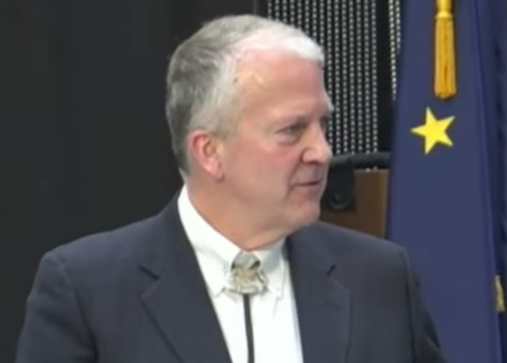
Sullivan Touts “Alaska Comeback,” Historic Opportunities, in Annual Address to Legislature
By Office of Senator Dan Sullivan on Comments Off on Sullivan Touts “Alaska Comeback,” Historic Opportunities, in Annual Address to Legislature
VII. Military Build-up
a. Alaska Military Comeback
So another comeback, critical to our whole nation and our great state, is the Alaska military comeback. Now, we know our history better than any other state. During some of our nation’s most existential crises, like World War II and the Cold War, Alaska played an immensely important role in defending America.
The “Father of the U.S. Air Force,” General Billy Mitchell, called our state the most strategic place in the world. And, for a time, our military posture reflected that truth. But when we won the Cold War, something dangerous began to happen. The Pentagon’s understanding of Alaska’s importance faded.
Bases closed. Armories shuttered across western Alaska. Alaska drifted from strategic cornerstone to strategic backwater in the eyes of many in the Pentagon.
I saw this national security amnesia about our great state firsthand when I arrived in the Senate in 2015. The Obama administration had put out its Arctic strategy. I was at a hearing with the brand new Secretary of Defense, and I held it up. I said: “Mr. Secretary, here’s your Arctic strategy. It’s 14 pages long, half of which are pictures. You talk about climate change the whole time. And you mentioned Russia as a threat once in a footnote.” I called it what it is. Slammed it on the dais. I said, “This is a joke. This is a joke. “The Pentagon has to do better.
The Obama administration then announced a cut of an additional 40,000 active duty Army troops in America, including the 5,000-strong JBER-based 4/25, the only airborne brigade combat team in the entire Asia Pacific. Just a few years later, the Coast Guard then announced it had plans to reduce its presence in Alaska.
Now, our military leaders over the years had forgotten how important Alaska was from a national security perspective for our country. But guess who didn’t? You didn’t. We didn’t. Alaskans didn’t. All of us, with our collective memory and knowledge—communities, veterans, legislators, families—we came together and made it clear that retreat was not an option. Cutting back on Alaska’s military was something we would fight. And we fought.
I also quickly learned as a new U.S. Senator the value of certain Senate prerogatives, especially putting holds on senior military and civilian confirmations until I got from them concrete commitments to build up forces in Alaska, not to draw them down. Slowly but surely, with everybody’s help and our great state—and it was a collective effort—Alaska’s military comeback began, and now it is in full force.
We are now undergoing the largest military build-up and expansion—billions of dollars in investment—since World War II.
The 4/25 at JBER, it didn’t get shuttered. It expanded into the U.S. Army’s 11th Airborne Division, now fully centered in Alaska.
Eielson didn’t close. It’s now home to two squadrons of F-35s, and when combined with the two squadrons of F-22s at JBER, it gives Alaska over 100 fifth generation fighters. No place on the planet Earth has that kind of fifth-gen fighter combat power. More KC-135 tankers are enroute to Alaska.
I just had a stern conversation with the Secretary of the Air Force about this a couple of days ago. Our role as the cornerstone of missile defense—protecting the whole country—is expanding significantly, particularly in the Interior, with the billion-dollar Long Range Discrimination Radar finalized at Clear, and the Golden Dome initiative, which in the Working Families Tax Cuts Act has about $25 billion for investment.
The Ted Stevens Center for the Arctic, with over 60 dedicated veterans at JBER, has rapidly become one of the world’s premier national security think tanks.
The infrastructure we need in Alaska to project American power is expanding, with a half-billion-dollar investment in a brand new runway at JBER, $400 million to build the deep-water strategic port in Nome, and my favorite, also in the Working Families Tax Cuts Act: $115 million to start reopening the Navy base at Adak, one of the most strategic places in the world.
Now, even my beloved Marine Corps recently came to me at a senior level, saying, “Senator, we have plans to expand in Alaska.” I’m like, “Hey, Marines, you’re usually the first to fight.” Like, get on with it, man. Let’s go.
But it is the Coast Guard comeback in Alaska that is truly historic. The Coast Guard didn’t downsize it.
They were planning that in Alaska, and I made sure of that by putting a hold on the confirmation of the Commandant of the Coast Guard until he provided me with a plan to expand the Coast Guard’s presence in Alaska, which we are now doing in so many communities, with hundreds of millions of dollars of investments in Kodiak, Ketchikan, Seward, Sitka, Valdez, Petersburg.
Everybody loves the Coast Guard. It’s very true. Everybody loves the Coast Guard. I read that list, but I didn’t get to probably one of the most—and certainly one of the most important on the expansion—right here in Juneau, the Coast Guard expansion. Again, if you look at the Working Families Tax Cuts Act handout, on the back page, it talks about the largest investment in Coast Guard history in American history from this bill. It’s a $25 billion investment to fully rebuild our Coast Guard.
As the chairman of the Coast Guard subcommittee, I was very honored to write a lot of this. But take a look at the numbers: 16 new icebreakers, 22 new cutters, 40 new helicopters, almost $4.5 billion in shoreside infrastructure, $300 million for Juneau, Alaska to homeport the icebreaker Storis right here, which is going to happen.
But we are not done. I recently chaired a Coast Guard subcommittee hearing with the Commandant of the Coast Guard. When I asked them about the potential for more icebreakers being homeported in Alaska—imagine that, homeporting an icebreaker in the state with the ice— he responded by saying the Coast Guard is considering homeporting up to four more icebreakers in our great state. Even I was shocked by that.
This Coast Guard comeback is spurring some of the most exciting economic activity we’ve seen in years. It’s not getting covered by the press, but it is really exciting: a boom in shipbuilding and heavy maintenance activity throughout our state, from Kodiak to Seward to Ketchikan, perhaps even in Wrangell.
I was with Senator Stedman and Representative Bynum just a couple of days ago in Ketchikan, and you can’t believe what’s happening with this shipbuilding boom. These are great paying jobs that have expanded by the hundreds in our state in the communities that I just mentioned, with room to grow as we get more ships from the Coast Guard and NOAA.
It is a really exciting element of our growing economy.