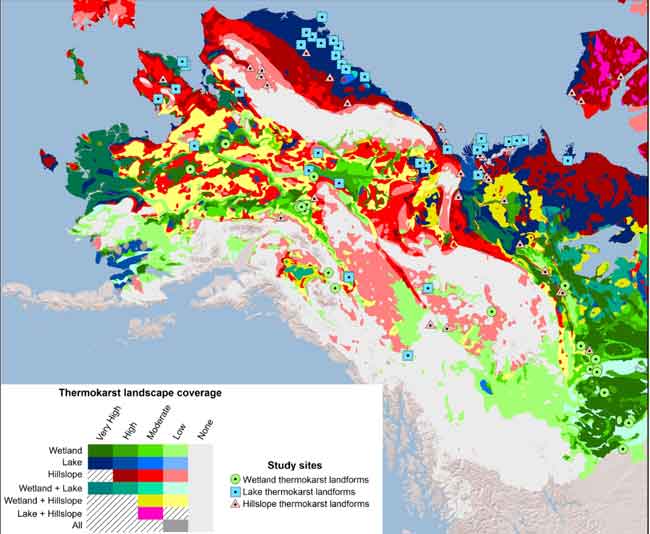
A new mapping project has identified regions worldwide that are most susceptible to dramatic permafrost thaw formations, known as thermokarst, and the resulting release of greenhouse gases. University of Alaska Fairbanks researchers David McGuire and Vladimir Romanovsky were part of the project, which was led by University of Alberta researcher David Olefeldt. They found […]
LOS ALAMOS, N.M.—A new study of permafrost has found that the ice wedges forming the prevalent honeycomb pattern across the tundra appear to be melting rapidly across the Arctic, changing the hydrology of the region and accelerating the release of greenhouse gases with major implications for global warming. While the gradual warming of permafrost has […]
CHAMPAIGN, Ill. — A new analysis of fire activity in Alaska’s Yukon Flats finds that so many forest fires are occurring there that the area has become a net exporter of carbon to the atmosphere. This is worrisome, the researchers say, because arctic and subarctic boreal forests like those of the Yukon Flats contain roughly […]
Last week, I wrote about a thought experiment proposed by Fairbanks scientist Jim Beget. He suggests raining down crystals of a compound that captures carbon dioxide onto a frigid plateau in Antarctica. There, the greenhouse gas might remain locked for a few hundred thousand years. Beget will present his idea at the fall meeting of […]