By Alutiiq Museum on Comments Off on Water-Alutiiq Word of thhe Week
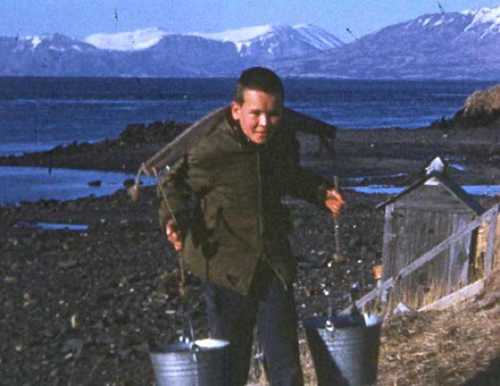
Photo: Boy in Larsen Bay carries water buckets with the help of a wooden yolk. Smith Collection, courtesy of Tim and Norman Smith.
Water — Taangaq Tamiinek taangaq aturtaarpet. – We use water in everything.
Freshwater is a plentiful resource in the Kodiak Archipelago. Although the region contains few large rivers, more than eighty inches of precipitation fall each year, and many small streams funnel rainwater and snow melt down steep mountainsides to the coast.
Alutiiq villages were often built near a reliable source of freshwater, a pond, or a stream where water could be collected for drinking, cooking, bathing, healing, and manufacturing. Residents hauled water to their houses in bentwood buckets and tightly woven baskets, where it was stockpiled in containers fashioned from seal stomachs. Families drank water from woven cups or sucked it out of gut containers using straws made from the dried stems of cow parsnip plants. Vessels used for hauling water were also used for cooking. People added fire-heated rocks to boxes filled with food and water to cook their contents. Water was also a preservative. Berries, for example, could be kept fresh for months in cool or frozen water.
An Alutiiq legend recorded at the turn of the nineteenth century tells of the origins of water, both fresh and salt. According to this legend, a man and a woman descended from the sky in a seal bladder. The man scattered his hair on the mountains, creating trees and forests, while the woman produced the ocean by urinating and the rivers and lakes by spitting into ditches. Yup’ik and Iñupiat peoples tell a very similar story, illustrating the deep ancestral ties among Alaska’s coastal societies.