Kelp Farms and Marine Life Co-Exist in Southeast Alaska
By NOAA Fisheries in Alaska on Comments Off on Kelp Farms and Marine Life Co-Exist in Southeast Alaska
Scientists teamed up to investigate how kelp farms may provide novel habitat for fish and invertebrate species.
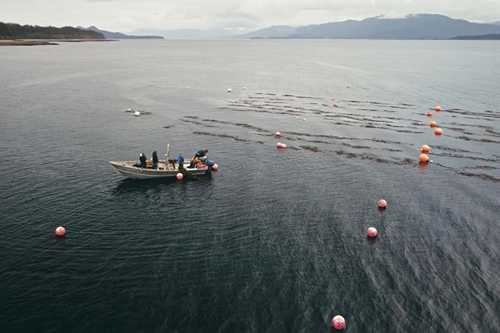
NOAA Fisheries and Sea Quester Farms partnered up to evaluate if kelp farms provide habitat for marine life in Alaska. Pictured here is one of Sea Quester’s farms in southeast Alaska near Juneau. Credit: Hatch Blue, Alaska Mariculture Cluster
Marine aquaculture, or mariculture, provides economic opportunities for coastal communities in Alaska through farming shellfish and seaweed. NOAA Fisheries continues to support Alaska’s growing aquaculture industry through policy and permitting—providing access to resources and research.
A recent study highlights one of our newest aquaculture research collaborations. Through this partnership between the Alaska Fisheries Science Center and Sea Quester Farms, we investigated whether seaweed farms provide novel habitat for Alaskan marine species. We compared the fish and invertebrate species present within Sea Quester farm sites to similar locations with no farms, and found no major difference. The research provided a better understanding of how kelp farms interact with the environment, which could help inform sustainable management.
“This study responded to a direct need from resource managers and interest from farmers to understand specifically how the presence of kelp farms in Alaska influenced culturally and economically important fish and invertebrate species,” said Jordan Hollarsmith, Ph.D., lead author and macroalgae and mariculture research biologist at the Alaska Fisheries Science Center.
Diving into Kelp Aquaculture Research
Worldwide, seaweed aquaculture is a rapidly growing industry. An increasing number of seaweed farms are sprouting up in the United States, including in Alaska.
Beyond boosting sustainable seafood production, seaweed farms offer expanding opportunities for maritime employment and support vibrant working waterfronts. Across the nation, they generate vital economic growth in coastal communities. With its vast coastline offering cold, clean, and nutrient-dense waters, coastal Alaska is ideally positioned for seaweed aquaculture.
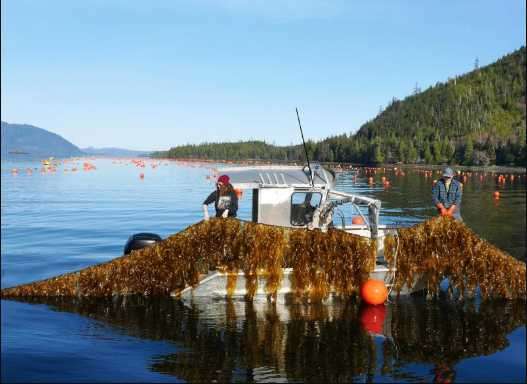
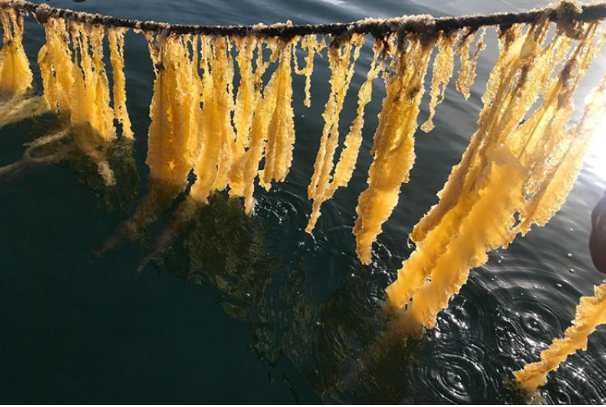
Most Alaskan kelp farms are small (20–30 acres) and primarily grow annual species. They are scattered sparsely across state waters and active only throughout the fall, winter, and spring seasons. Farmed kelp is grown on lines a few meters below the surface where there’s plenty of light and farmers can easily tend to their crops. Each fall, farmers seed the lines with juvenile kelp in land-based hatcheries. In winter, they transfer the lines to coastal farm sites. They harvest adult kelp in spring and early summer. After harvest, many farmers remove their in-water gear to minimize fouling and prevent environmental impacts. This makes farmed kelp a unique, and temporary, type of habitat.
Research for this study took place at Sea Quester Farms, located 10 miles west of Juneau. In these 10- and 25-acre sites, Sea Quester commercially grows various native kelp species including bull kelp, split kelp and sugar kelp.
Beginning in 2024,we sampled four sites over 2 years—two with kelp farms and two nearby control sites. The control sites had the same conditions and bottom type as the corresponding farm site, but without the farm infrastructure. Both the farms and control sites were located on hard cobble and muddy bottoms with wild kelp present, but without dense kelp beds.
We sampled each site by diving with scuba gear. We started with baseline surveys of the sea floor substrate and performed visual surveys for marine invertebrates. We also collected and processed water samples for environmental DNA. These samples allowed us to identify fish present by the DNA they leave behind in water. And with each sampling event we collected additional water samples to measure nutrient concentrations, temperature, and salinity.
As the kelp aquaculture industry grows in Alaska more animals are being exposed to kelp farms. Our research aims to ensure that kelp farms are managed sustainably.
How Does Marine Life Use Kelp Farms?
NOAA’s findings indicate that kelp farms neither enhance nor detract from the important habitat that existed prior to the farm’s operation. Farms had a neutral impact on the local environment, and did not shelter unique groups of species compared to areas without a kelp farm.
The waters of Southeast Alaska are highly seasonal and represent location-specific environments. The findings suggest that kelp farms in this area don’t have a measurable impact on either the composition of fish and invertebrates, or water quality conditions. “Our findings show that at these sites, kelp farms did not change what species we observed in each location. This indicates that these farms can co-exist with the biological richness already present,” said Hollarsmith.
These data could support aquaculture decision-makers in Alaska as the industry grows. Future research could investigate if the size of farms, local environmental conditions, and harvest methods have different positive or negative impacts on fish and invertebrates.
The aquaculture industry and NOAA Fisheries’ managers and researchers worked together to fill a critical knowledge gap and help responsibly advance kelp aquaculture in Alaska. “This work was made possible thanks to the interest from the Sea Quester Farms team and the access they granted us to their farm. The most impactful science is that which is done in partnership,” said Roger Wilder, a Hollings Scholar who assisted in this research.
This collaborative study was supported by the NOAA Fisheries Office of Aquaculture, with funding from the Internal Competition for Aquaculture Funds. It was conducted by scientists from:
This research helps ensure continued sustainability and expansion of these aquaculture operations in Alaska and help meet the goals set forth by the Alaska Mariculture Task Force.