Early in the morning of August 10th, 2025, a large landslide triggered a massive tsunami in the Tracy Arm Fjord in Alaska – a place frequented by tour boats and commercial cruise ships. In a new analysis, researchers show how this event unfolded and highlight both the growing hazard from similar events and the possibilities for early event detection. Landslide-generated tsunamis can produce extreme, localized inundation far exceeding that of earthquake-driven waves, posing distinct hazards in confined environments like fjords. As glaciers retreat, permafrost thaws, and human activity intensifies across the Arctic and Subarctic, both the likelihood and potential impact of these events are rising, underscoring the urgent need for improved detection and risk mitigation.
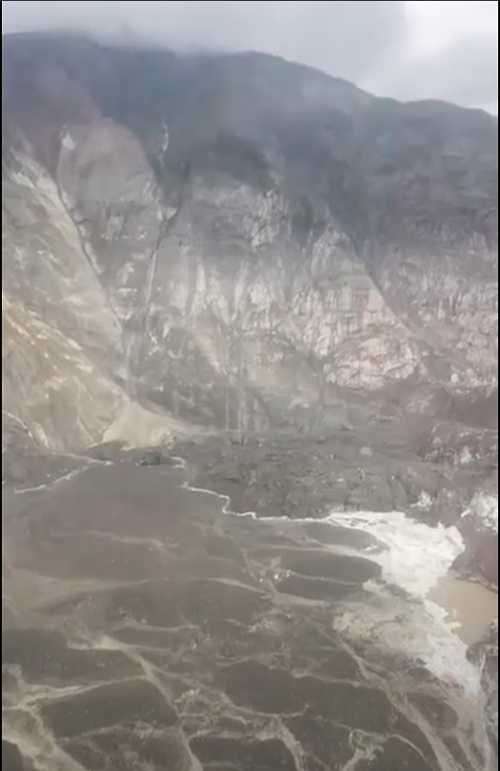
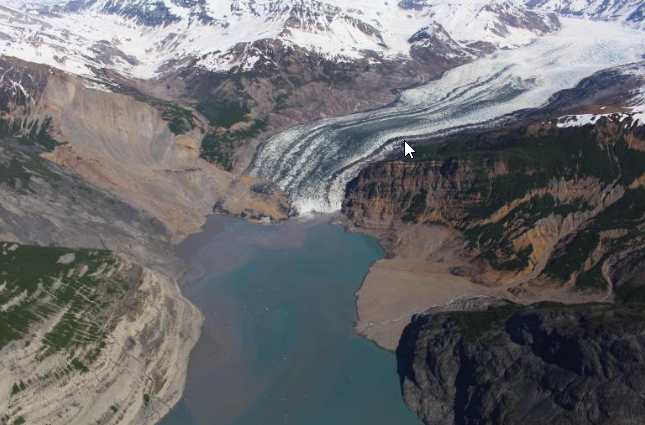
Image from video by Lt. Chip Baucom and Cdr. PJ Johansen, U.S. Coast Guard
Debris from an Aug. 10, 2025, landslide in Southeast Alaska spilled into Tracy Arm and onto South Sawyer Glacier. Dirt, rock and debris now fill an area of the fjord in the lower left of the photo.
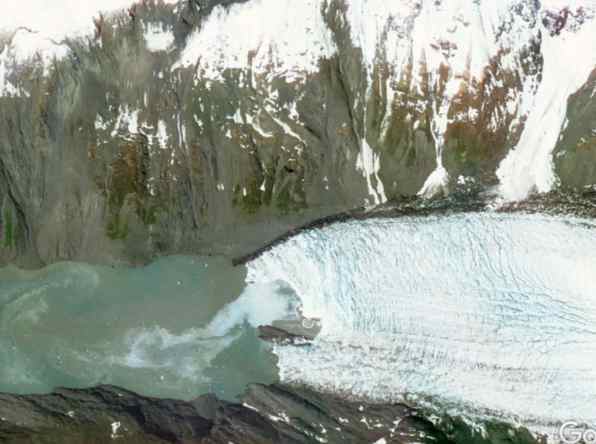
Dan Shugar and colleagues focused on the August 2025 event in the Tracy Arm Fjord, south of Juneau, Alaska. During the summer months, more than 20 boats per day visit the fjord, some carrying thousands of passengers. According to the authors, in the early morning of the megatsunami there, a massive wedge-shaped rock mass high above South Sawyer Glacier, which terminates in the fjord, collapsed, releasing tens of millions of cubic meters of material that struck the glacier terminus, displacing ice and water. This generated a powerful tsunami. Although the slope showed little visible warning beforehand, subtle seismic signals reveal a buildup of instability in the days – and especially hours – leading up to failure. The landslide itself produced long-period seismic waves equivalent to a magnitude 5.4 earthquake that was detectable worldwide. Shugar et al. argue that the collapse was likely primed by long-term glacier retreat and thinning, driven by regional warming, which removed structural support from the slope and left it increasingly prone to failure. As the tsunami surged out of Tracy Arm, it stripped vegetation from steep fjord walls, leaving a distinct high-water “trimline” that reached 481 meters above sea level, at points. Although wave heights diminished with distance, the tsunami still removed vegetation, reshaped shorelines, and produced measurable runup tens of kilometers away. Beyond the initial wave, the event triggered prolonged oscillations of water within the fjord, also known as a seiche, that persisted for hours to days and was detectable in both seismic and satellite data. This long-lived resonance, effectively a “ringing” of the fjord, as well as the pre-landslide seismic activity, offer potential new tools for identifying and monitoring landslide-generated tsunamis in remote regions, particularly as climate-driven glacier retreat increases the likelihood of such hazards. “A promising area of further investigation,” write the authors, “could be improved understanding of precursory warning signals either from direct measurement or remote sensing.”