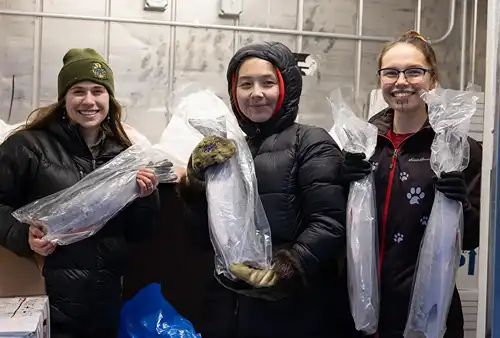
Terese Vicente, Annie Masterman and Robin Masterman pack up salmon for distribution through the ex-Typhoon Halong traditional foods drive. Photo by Katie Basile/Alaska Sea Grant.
Ex-typhoon Halong couldn’t have come at a worse time for residents of the Yukon-Kuskokwim Delta—or for their freezers.
“It’s fall time when the storms usually hit,” explained Katie Basile, Alaska Sea Grant coastal resilience specialist for the Yukon-Kuskokwim Delta. “This is after families have worked all summer and fall to hunt and fish and gather their food stores. So, it’s just an especially devastating time to lose food.”
Halong struck Southwest Alaska with devastating force in early October, largely destroying the coastal communities of Kipnuk and Kwigillingok, causing significant damage to more than a dozen villages, and displacing 1,600 people to Anchorage, Bethel and elsewhere. One of the organizations responding to the crisis was the American Red Cross, which donated new freezers to households in impacted communities—but not food to put in them. So the Kuskokwim River Inter-Tribal Fish Commission put together a food drive, with the help of Basile, the Association of Village Council Presidents, the City of Bethel, and the Bethel Community Services Foundation. “We all chatted and decided that between all of the groups, we had the capacity to fill some freezers,” Basile said.
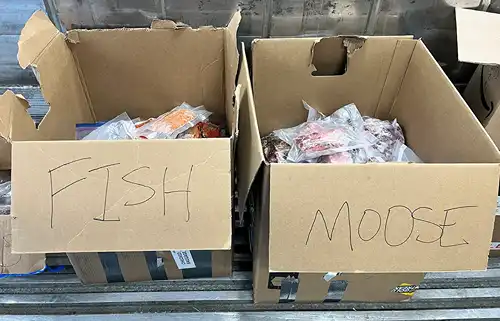
The resulting effort had the trappings of a typical food drive: the partners advertised online, put up flyers and arranged for a collection site in Bethel. But what made this drive unique was the food itself, because the organizers didn’t ask for flour or rice, but rather the meat, fish and plants that make up a traditional Alaskan subsistence diet. Basile said the result was a bounty of berries, moose meat, pike and other dried whitefish, seal oil, different types of wildfowl, and more.
“There was a grassroots thing happening already because that is a huge part of the culture out here, making sure people don’t go hungry, and that subsistence-caught food in particular is meant to be shared,” Basile noted. “What we’re doing is really supporting and supplementing the effort that was already happening on the ground.”
Contributions to the ex-Typhoon Halong traditional foods drive. Photo by Teresa Vicente/Kuskokwim River Inter-Tribal Fish Commission.
Basile estimated 3,000 to 5,000 pounds of food was donated by individuals. Another 15,000 pounds of coho salmon came from the nonprofit SeaShare and 1,000 pounds from the Alaska Longline Fishermen’s Association. The drive benefited from community support from all corners—not just donations of food, but also funding, volunteer labor, storage and collection space, and air transport. “People have been really generous,” Basile said. “People are already strapped, and so it’s a hard time to ask for more, but they continue to give.”
Volunteers began distributing the food before the holidays and continued into the new year, with some given to evacuees in Bethel and other food distributed via plane or ice road to residents of eight impacted villages. Basile estimates they’ve reached more than 80 families, which they located based on a process for requesting help, and also by reaching out to villages that received Red Cross freezers. “It’s been tricky to track all that information down and then connect with people, but we’re making it happen.”
Basile is leading additional community resilience efforts in Halong’s wake. She’s co-producing a film with the National Science Foundation’s Navigating the New Arctic Community Office that centers on interviews with Halong evacuees and researchers. The project highlights how Western scientific research, local and traditional knowledge, and past experiences with storms can help to build more resilient communities. Basile is also working with the Association of Village Council Presidents to identify future efforts. “There will be more recovery work down the road, for sure.”
In addition to the contributors mentioned above, other major donors to the effort included the Alaska Community Foundation, Ryan Air, Dale Construction, and Table of Grace Lutheran Church.