Native American Migration into Continent Came in Three Waves
By Staff on Comments Off on Native American Migration into Continent Came in Three Waves
The Native American population spans from Barrow all the way to the southern tip of Chile, from west coast to the east coast of two continents. Now, a new study shows that the people that populated this vast area came in three waves.
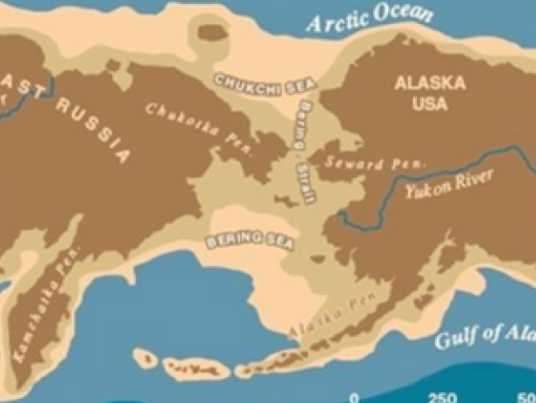
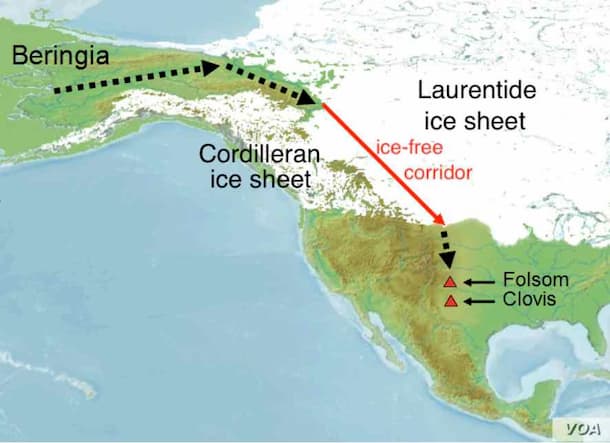
During the time period 15,000 years ago, during the ice ages,sea levels dropped as much as 350 feet, allowing for the bering sea land bridge to be exposed. It is this bridge used by the First Americans to enter the North American continent and eventually make up the vast majority of the later population in the New World.
Two other waves would come after. These waves make up the Eskimo-Aleut migration and the migration of the Na-Dene speaking Chipewyan from Canada according to the report published inthe journal Nature.
The study used DNA samples to show that even though two migrations came later, even they would mix routinely with the first migration. Data showed at least 50% of DNA from Eskimo-Aleuts was from First Americans. The Chipewyan have at least 90%.
A study of Native American DNA sequences was made possible by a collaboration of an international team of 64 researchers from the Americas, Europe, and Russia. The study used data from 52 Native American and 17 Siberian groups. Studying more than 300.000 specific DNA sequence variations to determine the dispersal of the first humans in the New World.
“For years it has been contentious whether the settlement of the Americas occurred by means of a single or multiple migrations from Siberia,” said Professor Andres Ruiz-Linares (UCL Genetics, Evolution and Environment), who coordinated the study. “But our research settles this debate: Native Americans do not stem from a single migration.”
The study also uncovered another fact of the migration south. Their DNA data showed that as populations moved south, groups diverged from the main group. Not to re-unite with the larger group again, as there was no subsequent gene flow after the split.
There are exceptions to this though. In Central America, DNA data shows that the Chibchan speaking group mixed with two very distinct groups, one from North America and one from South America.
The other is the back migration seen in Siberia, suggesting that people from North America crossed back over to Siberia at a later date.
“There are at least three deep lineages in Native American populations,” said co-author David Reich, Professor of genetics at Harvard Medical School. “The Asian lineage leading to First Americans is the most anciently diverged, whereas the Asian lineages that contributed some of the DNA to Eskimo–Aleut speakers and the Na-Dene-speaking Chipewyan from Canada are more closely related to present-day East Asian populations.”