Senate Unanimously Passes Sullivan-Whitehouse Bill to Combat Illegal Foreign Seafood Harvest
By Office of Senator Dan Sullivan on Comments Off on Senate Unanimously Passes Sullivan-Whitehouse Bill to Combat Illegal Foreign Seafood Harvest
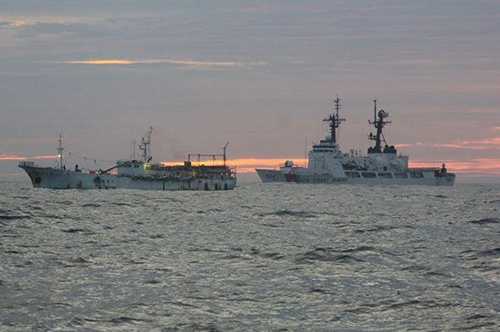
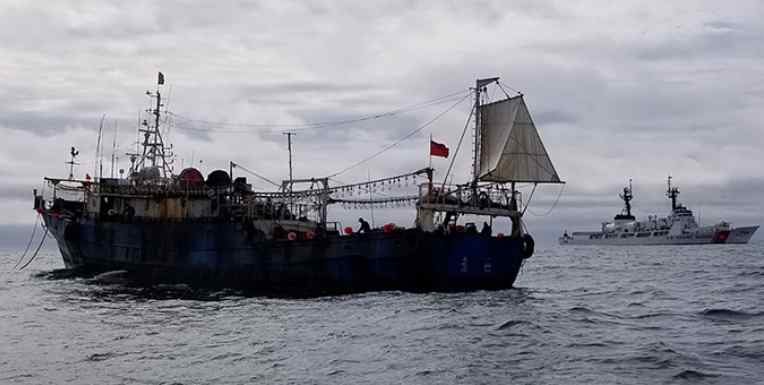
Coast Guard Cutter Munro interdicts an illegal drift net fishing vessel in the North Pacific. Image-USCG
WASHINGTON—U.S. Senators Dan Sullivan (R-Alaska) and Sheldon Whitehouse (D-R.I.) celebrated the Senate’s recent unanimous passage of their Fighting Foreign Illegal Seafood Harvest (FISH) Act. The FISH Act would combat foreign illegal, unreported and unregulated (IUU) fishing by blacklisting offending vessels from U.S. ports and waters, bolstering the U.S. Coast Guard’s enforcement capabilities and partnerships, and advancing international and bilateral negotiations to achieve enforceable agreements and treaties. The legislation is cosponsored by Sens. Lisa Murkowski (R-Alaska), Roger Wicker (R-Miss.), Lindsey Graham (R-S.C.), Jeff Merkley (D-Ore.), Lisa Blunt Rochester (D-Del.), Chris Coons (D-Del.), John Kennedy (R-La.) and Cindy Hyde-Smith (R-Miss.). House companion legislation has been introduced by Representatives Nick Begich (R-Alaska), Seth Magaziner (D-R.I.), and Dan Crenshaw (R-Texas).
“The geopolitics of the North Pacific and the Arctic are changing dramatically, with Russia and China increasing their aggression and ruinous activities near Alaska’s waters,” said Sen. Sullivan. “One particularly insidious threat is Chinese and Russian trawl fleets that ignore basic seafood harvest rules and best practices, and ravage fish stocks without regard for any other users or future generations. These fleets, which literally utilize slave labor in many cases, are a cancer on fisheries throughout the world and in Alaska and undercut our fishermen, who fish sustainably. I want to thank my Senate colleagues for advancing our FISH Act and helping us fight back against IUU fishing on behalf of our fishermen and coastal communities.”
“I was glad to work with Senator Sullivan, my longtime partner on oceans issues, to pass our bipartisan FISH Act through the Senate. By cracking down on illegal pirate fishing, we are leveling the playing field for hardworking Rhode Island fishermen who play by the rules,” said Sen. Whitehouse, co-founder of the Senate Oceans Caucus.
“Alaska seafood is sold in over 100 countries. Therefore, our fishermen and seafood processors must compete in the challenging global market,” said Jeremy Woodrow, executive director of Alaska Seafood Marketing Institute. “U.S. and Alaska seafood is regulated, harvested, and processed under the highest standards. In fact, in many cases, the U.S. sets the global standard. Unfortunately, numerous fisheries across the globe continue to operate illegally and unregulated. When these unchecked seafood products enter the global marketplace, they undercut the value of responsibly produced seafood. This impacts not only the marketplace but drives down the economic returns to Alaska’s fishing communities. Thank you, Senator Sullivan, for addressing this inequity and fighting for fairness on behalf of Alaska’s seafood industry.”
“Thank you, Senator Sullivan, for working to level the playing field for U.S. fishermen,” said Gabriel Prout, 3rd generation commercial fisherman, FV Silver Spray, and president of Alaska Bering Sea Crabbers. “While my family and I are out fishing Alaska crab, we can rest assured that you are working hard to address this problem that has cost Alaska fishermen over a billion dollars over the years.”
“I want to thank Senator Sullivan and Senator Whitehouse for working together to protect Alaska fishermen,” said Matt Alward, president of United Fishermen of Alaska. “Alaska’s seafood sector is facing very serious challenges. Illegal, unreported and unregulated foreign fishing exacerbates these challenges by undercutting lawful and sustainably caught American seafood. I’m grateful that Senator Sullivan is taking the issue seriously and working to crack down on IUU fishing through the FISH Act.”
“Silver Bay Seafoods commends Senator Dan Sullivan for his strong support for Alaska’s fishing industry. Alaska fisheries are highly regulated and sustainably managed,” said Cora Campbell, president and CEO of Silver Bay Seafoods. “This bill increases accountability for countries that do not have the same standards, which will help level the playing field and improve competitiveness of American sourced seafood.”
“Illegal fishing, and the human rights abuses associated with it, puts our oceans and fishers at risk. The United States must be a leader in holding bad actors accountable and leveling the playing field for U.S. fishers,” said Oceana Illegal Fishing & Transparency Campaign Director Dr. Max Valentine. “The FISH Act would help lift the veil on the identities of those involved in these illicit activities. Oceana thanks Sen. Sullivan and Sen. Whitehouse for their dedicated work to fight illegal fishing and protect American fishers and consumers.”
“NFI believes strongly in supporting concrete solutions to stopping and combatting Illegal, Unreported, and Unregulated (IUU) fishing,” said Lisa Wallenda Picard, president & CEO of National Fisheries Institute (NFI). “Where it occurs, IUU fishing harms effective fishery management measures and undercuts harvesters that fish legally and responsibly. NFI applauds Senators Sullivan and Whitehouse for the FISH Act and for understanding that there needs to be a process that targets bad actors where they are, instead of imposing regulatory burdens and costs on American seafood companies. We view the FISH Act as the definitive statute on IUU and look forward to its enactment.”
“Illegal fishing practices are uniquely destructive to global fisheries and the billions of people that depend on them,” said Molly Masterton, senior attorney at the Natural Resources Defense Council (NRDC). “By shedding a light on bad actors who benefit from skirting the law, the FISH Act takes important steps to better enforce against global illegal fishing and associated labor abuses in the seafood sector. Paired with tools to root out illegally harvested seafood from the U.S. market, it will also help level the playing field for U.S. fishing communities who play by the rules.”
Key provisions of the FISH Act:
Direct the National Oceanic and Atmospheric Administration (NOAA) to establish a blacklist of foreign vessels and owners that have engaged in IUU fishing.
Direct the administration to address IUU fishing in any relevant international agreement.
Direct the U.S. Coast Guard to increase its work with partner countries and increase at-sea inspection of foreign vessels suspected of IUU fishing.
Direct the administration to report to Congress on how new technologies can aid in the fight against IUU fishing, the complexities of the seafood trade relationship between Russia and China, and the economic costs of IUU fishing to the U.S.
In April 2025, President Trump signed an executive order, “Restoring American Seafood Competitiveness,” directing the Secretary of Commerce, U.S. Trade Representative (USTR), and Interagency Seafood Trade Task Force to assess seafood competitiveness issues and collectively develop a comprehensive seafood trade strategy. Among these strategies, the USTR will examine the relevant trade practices of major seafood-producing nations, including IUU fishing and the use of forced labor in the seafood supply chain.
In April 2025, the Senate Commerce, Science & Transportation Committee unanimously passed the FISH Act from committee.
On June 12, 2025, Sen. Sullivan, chairman of the Senate Commerce, Science, and Transportation Subcommittee on Coast Guard, Maritime, and Fisheries, chaired a hearing on the threat of foreign IUU fishing to America’s and Alaska’s fishermen and coastal communities.
In October 2025, The FISH Act passed the Senate as part of the Senate version of the FY 2026 National Defense Authorization Act, but was not included in the final bill that was signed into law.
Senators Sullivan and Whitehouse have worked together extensively on ocean sustainability issues, most notably on the Save Our Seas 2.0 Act, the most comprehensive legislation ever to address the global marine debris crisis, which became law in 2020.