A new study led by Colorado State University has found that glacial lakes in Alaska are expanding at an accelerating rate as glaciers melt, with rapid expansion over just six years. The research also projects where lakes could grow or form in the future – critical information for planning and public safety.
The study found that from 2018 to 2024 – in just six years – glacial lakes in Alaska grew 50% faster than they did from 2009-2018. In that time, Alaskan glacial lakes expanded 156 square kilometers, or about 60 square miles – slightly larger than the size of Fort Collins. The current growth rate is more than twice the rate recorded from 1986 to 1999.
“Even though I am accustomed to seeing dramatic examples of glacier retreat, the changes in the past six years are staggering,” said lead author Dan McGrath, a CSU associate professor of geosciences.
Glacial lakes change the surrounding environment and can drain suddenly and destructively in outburst floods, impacting people, ecosystems and infrastructure. The more water stored in a glacial lake, the greater the magnitude of potential outburst flooding.
“A primary motivation for studying glacial lakes is understanding the hazards they present,” McGrath said. “Previous studies have documented that glacial lakes are growing in number and area globally and draining more frequently. The outburst floods that originate from these lakes can have devastating impacts.”
Millions of people around the world are at risk from glacial lake outburst flooding, mostly in the high mountains of Asia and South America. Neighborhoods along the Mendenhall River in Juneau, Alaska, have been repeatedly inundated by outburst flooding from Suicide Basin on the Mendenhall Glacier. Mendenhall Glacier is a small glacier, and only one of roughly 27,000 glaciers in Alaska, yet it has an outsized impact on one of Alaska’s largest population centers.
With Alaska’s low population density, most of the large glacial lakes studied do not pose an immediate threat to people. But infrastructure, such as roads and railroads, may be at risk, and ecosystems will change dramatically as the landscape is reshaped. New and growing lakes will alter streamflow, sediment transport and storage, and water temperature, all of which have ecological impacts.
Knowing where lakes could form and expand in the future can help with infrastructure planning as Alaska’s landscape evolves, McGrath said.
“The scale of lake growth in Alaska represents a significant change to ecosystems and hazards, as well as recreational and tourism opportunities,” said Louis Sass, a glaciologist for the U.S. Geological Survey at the Alaska Science Center and McGrath’s primary collaborator on the study. “This work is a starting point for understanding where and when new lake growth will occur, which will be broadly useful to both scientists and land managers as we try to understand and predict those changes to ecosystems, hazards and recreation.”
Little has been known about the land surface beneath glaciers. McGrath used elevation and ice-thickness data to map the terrain hidden under the ice and reveal the deep basins carved by glaciers, called overdeepenings. Building on his previous research with former CSU Ph.D. student Brianna Rick, McGrath demonstrated for the first time that lake growth primarily corresponds with these landscape features.
It’s natural for these low points at the base of glaciers to fill with meltwater, and McGrath found that 80% of lake growth from 2018 to 2024 had indeed happened in these basins.
By calculating the area of these overdeepened basins connected to lakes today, McGrath and his colleagues showed that Alaskan glacial lakes could grow four times in size, by 4,250 square kilometers, or about 1,640 square miles, which is about six times the surface area of Lake Mead. Additionally, another 14,500 square kilometers, or about 5,600 square miles, of glacier-bed overdeepenings exist beneath glaciers in Alaska today, highlighting locations where lakes may form in the future as glaciers retreat.
“These results paint a picture of how the landscape will evolve in the coming decades to centuries, identifying areas where lakes will form and grow, as well as glaciers that are less prone to lake development given the shape of their beds,” McGrath said.
Glacial lakes are also important because they influence how quickly glaciers melt. The study, which was funded by the U.S. Geological Survey, found that glaciers with a toe in a lake – lake-terminating glaciers – thinned 23% to 54% faster than those without. Some glaciers withdrew enough that they became land-terminating, which slowed their melt rate.
“There is a tremendous amount of glacial ice remaining in Alaska today, but this ice is melting at the fastest rate of any region on the globe,” McGrath said. “Understanding where lakes will form, as well as how glaciers will respond to these lakes, is critical for accurate projections of glacier mass loss and sea-level rise in the future.”



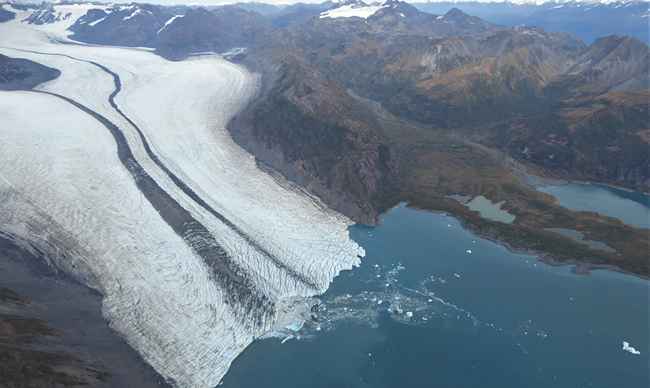




![Yakutat Icefield, an expanse of ice of about 310 square miles in southeast Alaska, is considered by glaciologists to be among the ‘walking dead’. The icefield no longer has an accumulation zone – the upper part of a glacier, where mass gains from snowfall exceed ice loss. [NASA/Maria-José Viñas]](https://alaska-native-news.com/wp-content/uploads/glacier-2.jpg "A Decade of Exploring Alaska's Mountain Glaciers")