As marine ecosystems change and technology advances, modernizing survey tools allows NOAA to maintain critical survey time series and deliver the best available science to support sustainable fisheries management
NOAA Fisheries conducts surveys to assess trends in fish populations, monitor ecosystem conditions, and support sustainable fisheries management. As ocean conditions shift and technology evolves, the Alaska Fisheries Science Center is modernizing its fisheries-independent bottom trawl surveys in Alaska. This will enhance efficiency, preserve long-term data continuity, and improve the quality of information used in assessments to manage valuable fish stocks.
The Team Modernizing the Mission
The FV Alaska Knight, owned and operated by United States Seafood, has been chartered to conduct the Bering Sea bottom trawl surveys for the last 14 years. Russell was the captain of the vessel prior to joining the survey research team at the Alaska Fisheries Science Center. Credit: NOAA Fisheries.
In collaboration with industry, resource managers, and state partners, researchers with the Center’s Groundfish Assessment Program are undertaking projects to modernize survey gear, statistical designs, and sampling methods. The effort is partially spearheaded by net shed and survey support team supervisor, Shawn Russell, and research fish biologist, Sean Rohan—both veterans of NOAA surveys. They share complementary visions for the project and expertise in statistical survey design, contemporary gear technology, and field operations.
For decades, surveys have reliably collected critical fisheries-independent data that informed high-stakes fisheries management decisions. However, gear and sampling designs that had been the standard of the mid-20th century need to be updated to adapt to changing ocean conditions and survey gear. “With this modernization effort, we’re trying to be proactive about the changes that we’re making, to make sure that we’re not forced into an unplanned transition,” notes Russell.
Russell provides firsthand knowledge of field operations and the practical challenges of implementing these gear changes. Before his current role with NOAA, Russell spent 26 years as a commercial fishing captain in Alaska—many of those on the FV Alaska Knight. During several summers, he also supported NOAA bottom trawl surveys. His unique insight ensures these gear updates will effectively and pragmatically improve haul operations and performance.
“Part of the modernization project for me is to try to resolve and reduce some of that variability in the gear,” Russell shares. “Applying new technology, such as new trawl doors that have more hydrodynamic foil capability, and which have better spreading capability throughout the depths, leads to trawl gear or nets that have a lower range of change in performance throughout the different environments.”
Rohan has spent the past decade assessing the survey from sea and his desk. He specializes in bottom trawl survey sampling methods, environmental data collection, and groundfish ecology. Explains Rohan, “My research includes statistical analysis that aims to calibrate between our past methods, our current methods, and the methods that we’re going to be using in the future to avoid any disruption in the time series.”
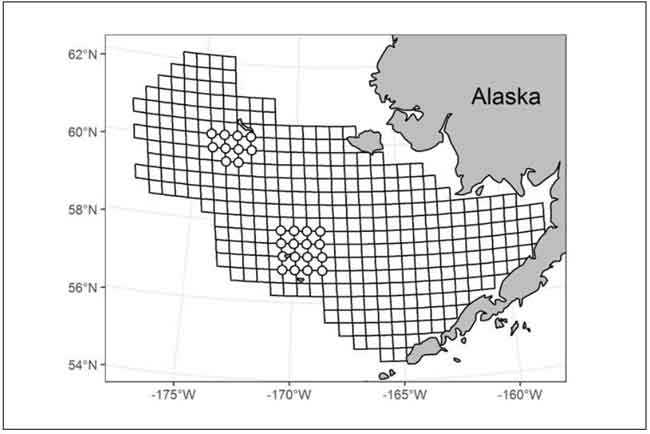
“The data that we collect feeds into stock assessments that support some of the largest commercial fisheries in the world. Both the survey gear and the survey design that we’re currently using in the Bering Sea is a legacy of sampling that started in the 1950s. And there have been a lot of improvements in technology and our statistical knowledge over time.”
A key step in modernizing the trawl survey gear is to test the new gear in controlled conditions. Rohan and Russell, along with other survey scientists, industry leaders, net design specialists, and vessel captains, recently visited the Marine Institute in Newfoundland, Canada. They evaluated scaled model nets in a flume tank and observed their performance (how the net flutters, touches the bottom, and rides) in simulated ocean currents.
Russell describes the flume tank as “an Olympic-sized swimming pool that’s approximately 20 feet deep and 150 feet long. It has a treadmill on the bottom that simulates trawls moving over the ground, while large electric propellers create water flow to simulate ocean currents.” The comprehensive testing included 180 trials over the course of a week to compare current and prospective net designs.
Transparency with Partners
NOAA is committed to maintaining transparency, nurturing open communication, and collecting feedback from industry stakeholders. Rohan underscores that “the work that we’re doing here greatly impacts the Alaska fishing industry” and suggestions from these invested partners “can help improve the quality of our science.” Russell has personally seen the payoff of similar collaborations in practice. He highlights that “we’ve always approached this project as open and clear as possible with our stakeholders. And we’ve always tried to get their involvement.”
This mindset is crucial to building trust, ensuring the practicality and credibility of new methods, and aligning scientific advancements with the needs and insights of those directly impacted by fisheries science.
Survey Data for the Next Generation
Updating survey gear and technology will help bottom trawl surveys adapt to changing ocean conditions and ensure survey data continues to support sustainable fisheries in Alaska. Rohan and Russell bring a vital blend of innovation and field expertise to this effort.
“My reward is to help improve survey catch data, providing the best information possible to preserve these resources for future industries,” says Russell. Rohan adds, “Changing to a new survey design and adjusting our methods can help us adapt to ecosystem changes while ensuring we continue to provide high-quality data for fisheries management.” These advancements will help NOAA provide better science and management for sustainable fisheries and ecosystem health for decades to come.