Permafrost thawing may allow greenhouse gases to escape at a much higher rate than previously thought, and this could further accelerate climate change.
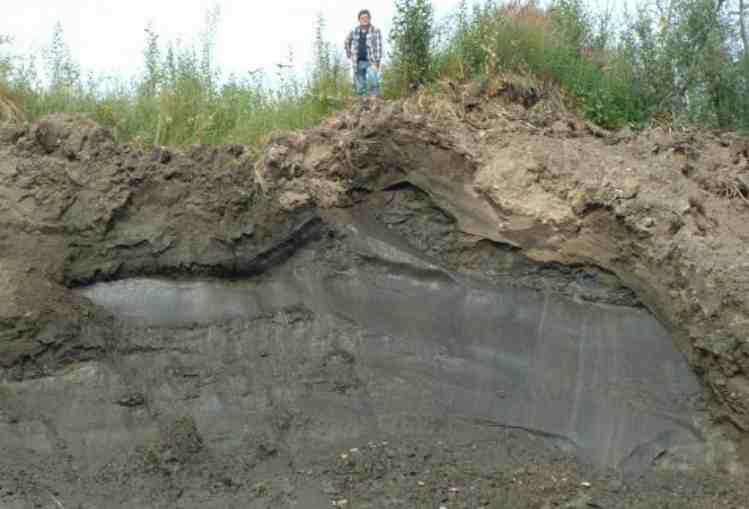
An ice-rich section of permafrost near Fairbanks. Near surface Permafrost Zones like these are more at risk of thaw. Image-Igor Semiletov
Experiments by University of Leeds researchers, published in AGU journal Earth’s Future, have shown that thawing of permafrost makes it between 25 and 100 times more permeable, allowing more climate change forcing gases to escape.
Permafrost – soil that has been frozen for extensive periods and is found over large areas in the Arctic – has historically acted as a vital barrier against climate change, but warming temperatures mean it is thawing.
The release of huge amounts of carbon that have been stored in previously frozen soils, predominantly in the Arctic, represents a very real danger
Globally, permafrost is estimated to contain 1700 billion tonnes of carbon, which is roughly three times the amount currently in the atmosphere.
The results suggest that thawing permafrost will accelerate climate change by releasing large amounts of greenhouse gases including carbon and methane, creating a self‑reinforcing process.
Professor Paul Glover, Chair of Petrophysics in the School of Earth, Environment and Sustainability at the University of Leeds, led the research. He said: “It is now widely recognised that climate change is leading to significant thawing of permafrost, with a 42% expected loss of permafrost in the Arctic Circumpolar Permafrost Region (ACPR) by 2050.
“The release of huge amounts of carbon that have been stored in previously frozen soils, predominantly in the Arctic, represents a very real danger, especially as it is known that climate change is warming the Arctic regions four times faster than elsewhere.
“The hypothesis that thawing of permafrost could release sufficient climate forcing gases not only to continue but to accelerate climate change is one step closer to being confirmed by the results we are publishing today.”
Carried out in Leeds’ Petrophysics Laboratory, the research measured how changing temperatures affect how gases flow through model permafrost as well as the amount of gas in the samples.
They thawed samples from -18C to +5C, measuring gas release at each degree, and found that the most permeability change occurred in the -5C to 1C range.
Co-author Dr Roger Clark, Senior Lecturer in the School of Earth, Environment and Sustainability at Leeds, co-authored the study. He said: “While these are significant results in themselves, showing how we are beginning to understand the mechanisms behind some aspects of climate change, they are also important because the measurements were only made possible by the adoption of methodologies previously developed for use predominantly by the fossil fuel industry.”
Professor Glover said that it was important to remember that these were initial published results, but that they were being corroborated daily by further measurements.
He added that the results were also significant for the Arctic release of the cancer-causing radioactive gas, radon, which could present a significant health risk for the Earth’s northern communities.