Tagged and Tracked: Mapping the Journeys of Pacific Cod in the Bering Sea
By NOAA Fisheries on Comments Off on Tagged and Tracked: Mapping the Journeys of Pacific Cod in the Bering Sea
How do Pacific cod respond to warming seas, and what does it mean for the future of fisheries? Satellite tagging helps scientists track cod migration in Alaska and understand the implications for stock assessments and sustainable management.
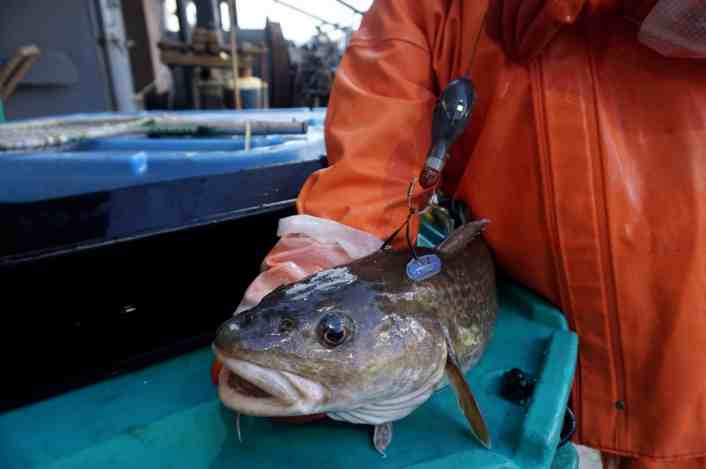
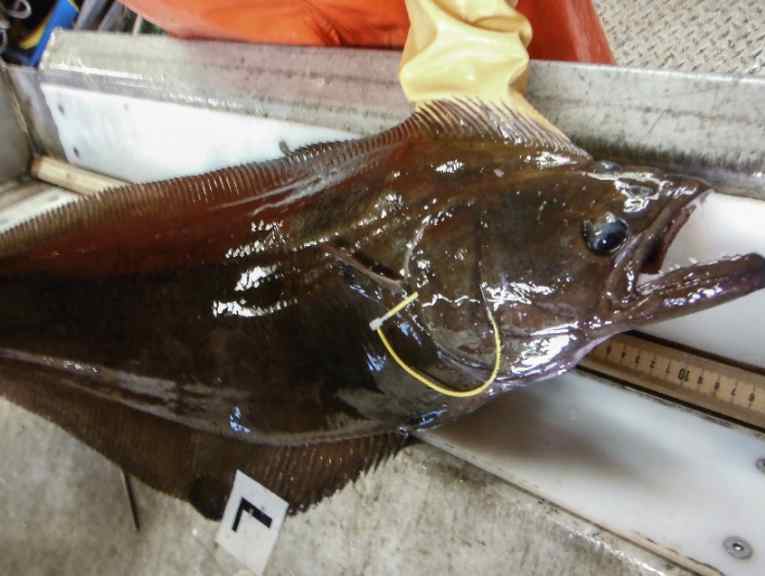
Pacific cod with satellite tag, ready to release. Credit: NOAA Fisheries
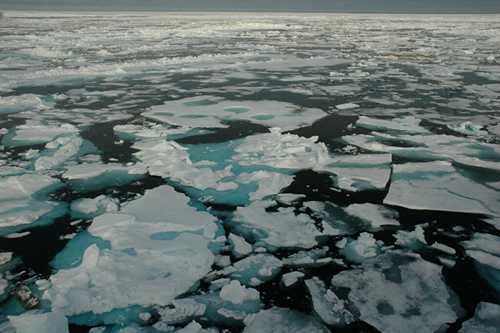
Pacific cod support Alaska’s second largest groundfish fishery and play a critical role in the Bering Sea ecosystem. In recent decades—particularly from 2017 to 2019—the Bering Sea experienced unusually warm temperatures and minimal sea ice. These conditions appear to have shifted Pacific cod distributions farther north compared to colder years, raising questions about long-term changes in population distribution and demographic structure.
Understanding a Shifting Species
In response to industry concerns and scientific data needs to support management, a research team launched a satellite tagging study in 2019. Led by Dr. Susanne McDermott—the Gulf of Alaska bottom trawl survey lead—the team included fisheries biologists Julie Nielsen, Kimberly Rand, and many others. McDermott recalled, “There was tremendous anxiety over what’s going on. Why are these fish in different places? Is this something that’s changing on a population level? Is this just the same population moving into different areas?”
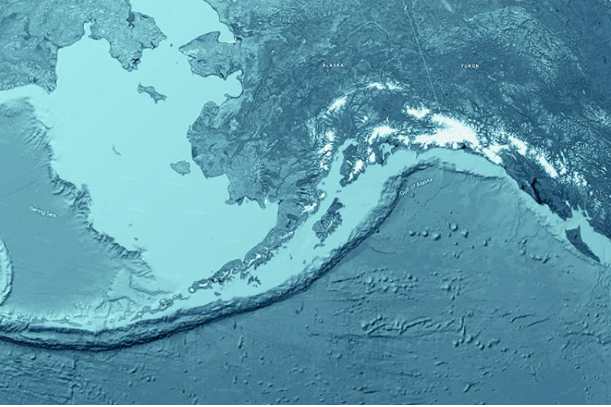
The summertime distribution of Bering Sea Pacific cod is usually centered in the southeastern portion of the region. Cod distribution typically varies with the extent of sea ice in the Bering Sea during the previous winter. It shifts northward in warm years and southward in cold years.
However, beginning in 2017, the Bering Sea experienced unprecedented warming that resulted in greatly reduced sea ice. In conjunction with warming waters, the summertime distribution of Pacific cod shifted dramatically northward into the northern Bering Sea. This study aimed to determine whether cod observed in the northern Bering Sea during the summers of 2017 and 2018 were a separate population from the southeastern Bering Sea. Or were they migrants?
Tagging fish can be a critical tool for understanding how and when fish cross regulatory boundaries. “When fish move across management boundaries, it really affects our management of that species because fishermen usually get assigned a certain quota in a certain management area. So, if fish move from one management area to another, they may not be able to catch them anymore,” explained McDermott. “That has a huge impact on the commercial fleet.”
Satellite Tagging for Management Insight
To answer these questions, the team deployed pop-up satellite archival tags to track the movements of Pacific cod. These tags collected high-resolution data on depth, temperature, light levels, and acceleration, providing a dynamic view of both fish behavior and their surrounding environments.
Light data allowed estimates of latitude and longitude based on time of sunrise, sunset, and local noon. Researchers used information on depth, longitude, and sometimes latitude to estimate daily locations of tagged cod using a geolocation model. Simultaneously being able to understand what time of day, season, environmental habitat, or region a fish is actively swimming in has provided critical insight into their behavior.
Attaching the pop-up satellite archival tags tag to a Pacific cod during the northern Bering Sea bottom trawl survey. Tags were attached with custom harnesses by inserting coated wire through harness pads directly under the first dorsal fin. Credit: NOAA Fisheries.
The tags detach from the fish after a programmed length of time, such as 30, 90, or 300 days. They float to the surface and transmit their data to the Argos satellite network. The number of tag transmissions were limited by battery life and summarized for transmission. Tags that were physically recovered—mailed back by fishers or beach combers—provided the full suite of data collected by the tags.
Nielsen was the team’s tag and modeling expert: “When you get the tag back,” Nielsen remarked, “you get data every second if it’s programmed for 90 days, every three seconds if it is out for 6 months or less, or every 5 seconds if it’s out for a year or longer.”
Rand assisted the team by processing the satellite tag models, communicating results, and writing manuscripts. “It’s really exciting when we dive into the data to find new and exciting patterns—things we haven’t seen before,” Rand shared eagerly. “We also collect genetics and otoliths for ages. It’s part of this comprehensive ecological picture.”
Rand has witnessed the evolution of tagging research technology, including early catch-and-release studies with conventional “spaghetti” tags. Those conventional tags only provided information on release and recovery locations. Detecting seasonal movements was very difficult if tagged fish moved away after tagging but returned prior to recapture. In contrast, pop-up satellite archival tags provided a detailed understanding of seasonal movements even if the tagged fish is not recaptured.
For this study, Pacific cod were tagged in both the summer and winter to track their movements year-round. Nielsen developed models that use the satellite tag data to reconstruct individual movement paths for the fish, and to deduce behavior. These contribute to a clearer understanding of cod life history.
Pacific cod tagged in summer in the northern Bering Sea left the area in November ahead of oncoming sea ice. Many went to traditional spawning areas in the eastern Bering Sea. However, some fish moved to Russian waters or the Gulf of Alaska during the winter, suggesting greater seasonal connectivity than expected. This demonstrated movement across international and management boundaries.
Supporting Resilient Fisheries
The team works with stock assessors to determine how these data and insights can be applied to stock and ecosystem assessments mandated under the Magnuson-Stevens Act. The team strategizes with the assessors to prioritize where they should release tags next to fill knowledge gaps. The effort helps to develop and support a framework for multi-area stock assessment models that incorporate fish movement across management zones.
“We’ve all worked together for a long time,” Rand shared, and “really care about the fishery.”
This research advances our understanding of how Pacific cod—and marine species more broadly—may adapt to climate-driven shifts in their environment. As the oceans continue to warm, these efforts will be useful for maintaining sustainable fisheries and resilient marine ecosystems. As scientists continue to evolve tagging methods, these advancements will help sustain healthy fish populations and support the broader marine ecosystem.